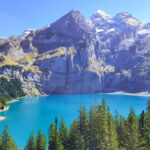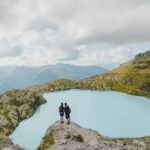
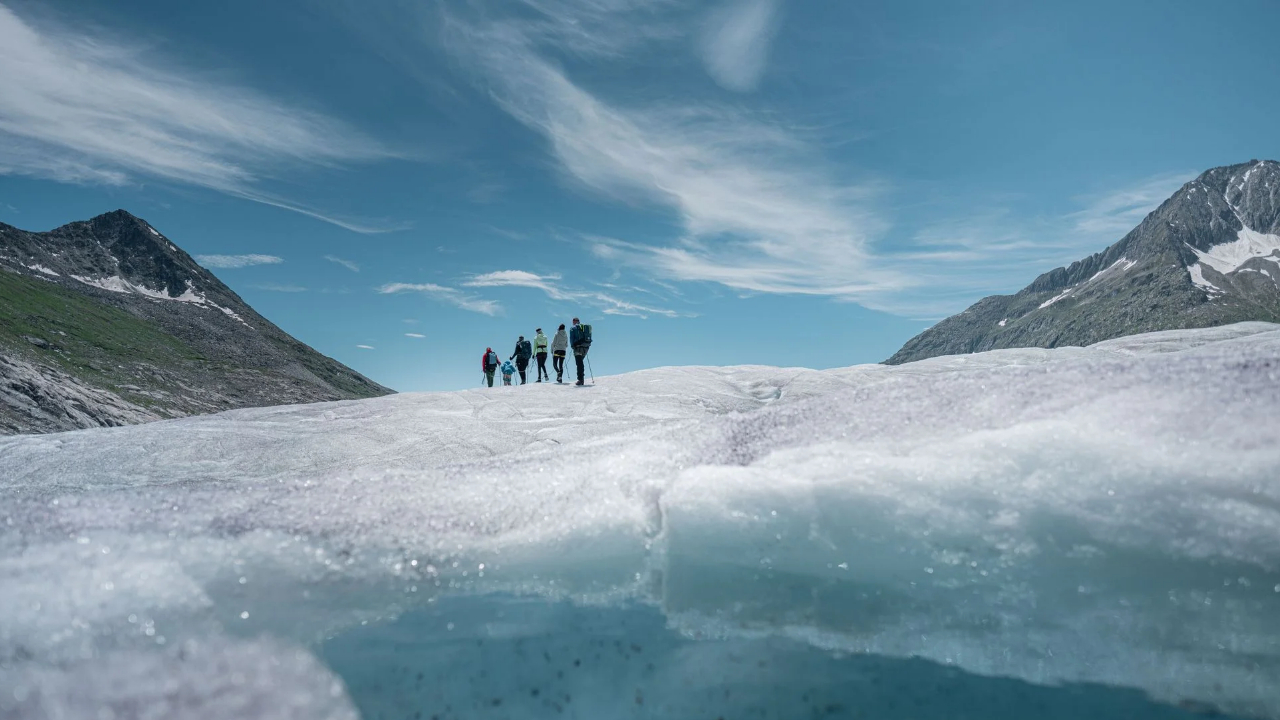
Aletsch Glacier is one of the most spectacular natural wonders in Switzerland and one of the most impressive places to experience the Swiss Alps. Stretching through the mountains of Valais and the Bernese Oberland, this enormous river of ice creates a landscape of dramatic peaks, deep valleys, Alpine forests, glacial lakes, rocky ridges, and panoramic viewpoints.
Recognized as part of the Swiss Alps Jungfrau-Aletsch UNESCO World Heritage site, Aletsch Glacier is famous not only for its extraordinary scenery but also for its geological and ecological importance. UNESCO describes the wider region as one of the most heavily glaciated parts of the Alps and identifies the glacier as the largest and longest in Europe.
For travelers, however, you do not need to be a glaciologist or experienced mountaineer to appreciate this remarkable landscape. Some of the best viewpoints are accessible by mountain railway, gondola, or cable car, followed by relatively manageable walks. The Aletsch Arena provides several panoramic viewpoints, including Eggishorn, Bettmerhorn, Moosfluh, and Hohfluh.
The region also offers much more than glacier views. You can walk through ancient Alpine forests, explore peaceful mountain villages, discover scenic lakes, enjoy panoramic hiking trails, visit nature centers, and learn about the forces that shaped the Alps.
Whether you are planning a Switzerland vacation, a hiking adventure, a photography trip, or simply looking for an unforgettable mountain landscape, Aletsch Glacier deserves a prominent place on your itinerary.
Why Visit Aletsch Glacier?
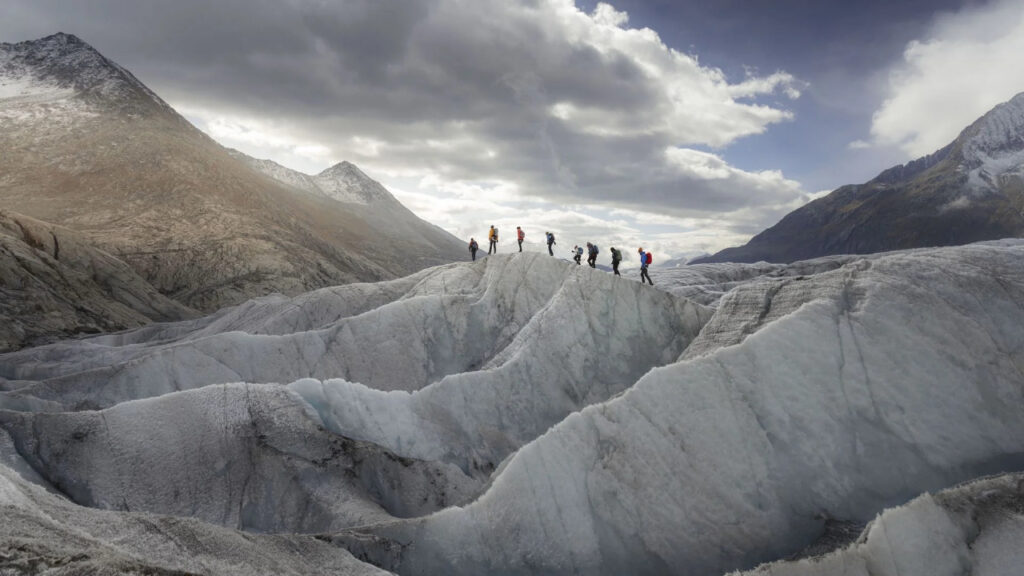
There are many reasons to visit Aletsch Glacier, but the most obvious is its sheer scale.
The glacier is not simply a small patch of ice visible from a mountain viewpoint. It stretches through an enormous Alpine landscape, surrounded by some of the highest and most dramatic mountains in Switzerland.
Switzerland Tourism describes Aletsch Glacier as the largest glacier in the Alps and notes that it forms part of the Swiss Alps Jungfrau-Aletsch UNESCO World Heritage site.
What makes the destination particularly appealing is the number of ways you can experience it.
You can admire the glacier from a high panoramic viewpoint, walk along mountain trails, explore the Aletsch Forest, visit nearby villages, or join a professionally guided glacier experience.
The landscape also changes depending on where you stand.
From one viewpoint, you may see the glacier winding between mountains. From another, you may look across the Rhône Valley toward distant Alpine peaks. Higher viewpoints can provide enormous panoramic perspectives, while forest trails offer a much closer connection with the surrounding ecosystem.
This variety means that a visit does not have to revolve around a single viewpoint.
Instead, you can build an entire day or even several days around the glacier and its surrounding landscapes.
See Aletsch Glacier from Eggishorn
Eggishorn is one of the most famous viewpoints for seeing Aletsch Glacier.
From this high mountain location, visitors can look down over the enormous sweep of the glacier while also seeing the surrounding peaks and valleys.
The viewpoint is particularly impressive because it reveals the glacier’s shape.
Rather than seeing only a small section of ice, you can appreciate how the glacier moves through the landscape.
The panoramic perspective helps explain why the glacier has such an important place in the geography of the region.
Switzerland Tourism specifically identifies Eggishorn as one of the top viewpoints for looking out over the Great Aletsch Glacier.
The journey to the viewpoint can also be part of the experience.
The Aletsch Arena is connected by mountain transportation, making it possible to reach high viewpoints without completing an extremely demanding ascent from the valley.
Once at higher elevation, visitors can choose from different walking routes depending on conditions and ability.
Eggishorn is especially appealing to photographers because it offers a broad perspective of the surrounding landscape.
On a clear day, the combination of ice, rock, snow, and distant peaks creates an unforgettable panorama.
Explore the Aletsch Arena
The Aletsch Arena is one of the main gateways for experiencing the glacier from the Valais side.
The region includes the car-free mountain destinations of Riederalp, Bettmeralp, and Fiescheralp, all located on an elevated plateau above the Rhône Valley.
According to Switzerland Tourism, the Aletsch Arena has six cableways connecting the valley with the mountain plateau and provides access to several major glacier viewpoints.
This makes the area particularly convenient for visitors who want to experience high-Alpine scenery without relying entirely on long uphill hikes.
Each village has its own character.
Riederalp provides access to mountain trails and the Aletsch Forest.
Bettmeralp is a popular base for exploring the glacier and surrounding mountains.
Fiescheralp provides access toward Eggishorn and other high-altitude experiences.
Because the villages are largely car-free, the atmosphere can feel peaceful and distinctly Alpine.
Walking through the villages also provides a chance to see traditional mountain architecture and enjoy views that extend far beyond the glacier itself.
For travelers who want to stay close to the mountains for several days, the Aletsch Arena can be an excellent base.
Visit Bettmerhorn
Bettmerhorn is another outstanding viewpoint overlooking Aletsch Glacier.
The location offers a combination of close and distant perspectives.
On one side, visitors can see the immense glacial flow. On the other, there are views toward the Rhône Valley and distant mountain peaks.
Switzerland Tourism describes Bettmerhorn as a location where visitors can learn more about the glacier and enjoy a dedicated viewpoint and exhibition.
The area also provides access to hiking routes.
One popular option leads toward Märjelensee, a scenic lake associated with the surrounding glacial landscape.
The route provides opportunities to experience the mountains from several different perspectives rather than simply standing at a viewpoint.
Travelers should always check current trail conditions before starting a hike, especially at higher elevations.
Weather, snow, ice, and seasonal trail conditions can change considerably.
A route that is straightforward during a stable summer day may be unsuitable under different conditions.
Walk to Märjelensee
Märjelensee is one of the scenic destinations that can be combined with a visit to the glacier.
The lake and surrounding landscape provide another perspective on the relationship between water, ice, rock, and Alpine terrain.
A popular hiking route connects the Bettmerhorn area with Märjelensee and continues toward Bettmeralp or Fiescheralp depending on the route selected.
Switzerland Tourism highlights a panoramic hike from Bettmerhorn via Märjelensee and through the Tälligrat tunnel toward Bettmeralp.
The route is appealing because the glacier remains a major part of the scenery while the landscape gradually changes around you.
Instead of experiencing the glacier from one fixed viewpoint, you can watch it from different angles as you walk.
Hiking also allows you to slow down.
There is time to stop for photographs, observe the surrounding mountains, and appreciate details that are easy to miss when moving quickly between attractions.
Before setting out, check current trail information, weather conditions, distance, elevation gain, and estimated walking time.
Discover Moosfluh
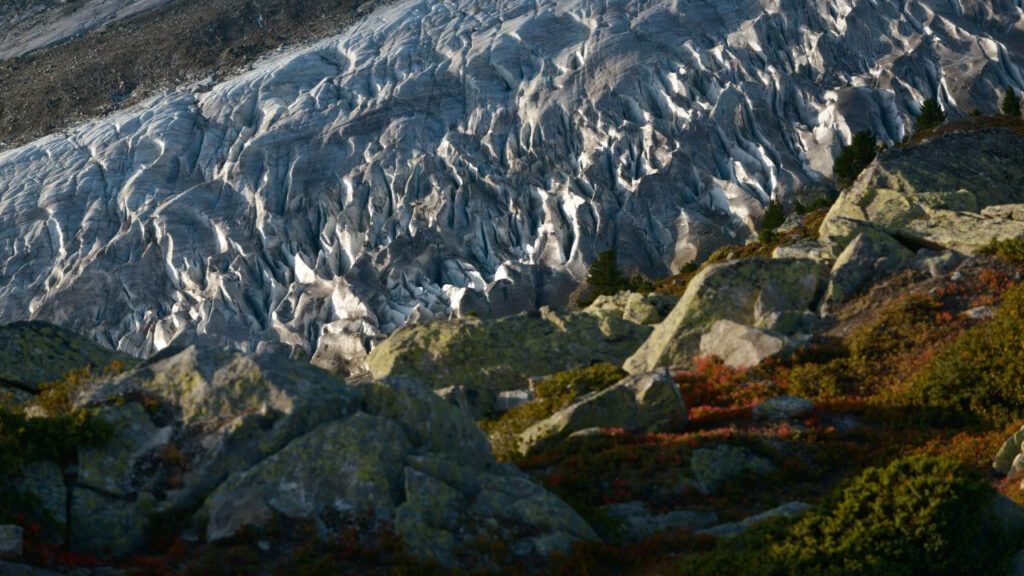
Moosfluh is another major panoramic viewpoint in the Aletsch Arena.
Like Bettmerhorn and Eggishorn, it provides dramatic views across Aletsch Glacier.
The viewpoint is accessible by mountain transportation and can be incorporated into hiking itineraries.
One of the advantages of visiting several viewpoints is that each reveals a different part of the landscape.
The glacier can appear completely different depending on the direction and elevation from which you see it.
Moosfluh is therefore an excellent choice for travelers who want to understand the glacier’s scale rather than simply capture one famous photograph.
The surrounding trails also make it possible to combine sightseeing with a longer outdoor adventure.
If you have several days in the area, visiting different viewpoints can provide a much richer experience than choosing only one.
Explore Hohfluh
Hohfluh is another viewpoint in the Aletsch Arena with impressive views toward the glacier and surrounding mountains.
The area can be combined with nearby hiking trails and other attractions.
One of the most enjoyable aspects of exploring the Aletsch Arena is the ability to create your own itinerary.
You might spend the morning at one viewpoint, hike through a forest in the afternoon, and finish the day in a mountain village.
This flexibility makes the region suitable for travelers with different interests.
Photographers can focus on panoramic views.
Hikers can link together several trails.
Families can choose shorter walks.
Travelers who prefer sightseeing can use the mountain transportation network to access scenic locations without undertaking long hikes.
The important thing is to check current operating schedules before traveling.
Mountain transportation is seasonal and can be affected by weather and maintenance.
Walk Through the Aletsch Forest
Aletsch Glacier is not only about ice.
The surrounding Aletsch Forest is one of the most fascinating parts of the wider landscape.
Switzerland Tourism describes the forest as an area that developed as land became uncovered by retreating glacial ice. It contains Alpine flora and fauna and includes Swiss stone pines that can be extremely old.
Walking through the forest provides a completely different experience from standing at a glacier viewpoint.
Instead of looking across a vast landscape, you become immersed in a smaller ecosystem.
Trees, plants, rocks, mountain paths, and changing light create a quieter atmosphere.
The forest also provides an opportunity to understand how landscapes change as glaciers retreat.
Newly exposed ground can gradually become colonized by plants, followed by more complex ecosystems.
This process is one of the ecological features that contributes to the scientific importance of the wider UNESCO World Heritage site.
The forest is therefore both beautiful and educational.
For travelers interested in nature, it can be one of the most rewarding parts of a visit.
Learn About the Glacier at Villa Cassel
The Pro Natura Center Aletsch at Villa Cassel provides another way to understand the environment around the glacier.
Located in the Aletsch Forest area, the center focuses on the natural environment and conservation.
Switzerland Tourism highlights Villa Cassel as a nature reserve center where visitors can learn about the protection of local flora and fauna.
A visit here can add context to what you see outdoors.
Instead of simply admiring the mountains, you can learn more about the plants, animals, forests, glaciers, and environmental changes that shape the region.
This is particularly valuable for travelers visiting with children or anyone interested in environmental education.
The combination of outdoor exploration and educational interpretation makes the destination more meaningful.
Understand Why Aletsch Glacier Matters
Aletsch Glacier is important far beyond tourism.
The glacier forms part of the Swiss Alps Jungfrau-Aletsch UNESCO World Heritage site, which was first inscribed in 2001 and later expanded. The protected property now covers approximately 82,400 hectares.
UNESCO identifies the region as an outstanding example of the formation of the High Alps.
The landscape contains geological features including U-shaped glacial valleys, cirques, horn peaks, moraines, and valley glaciers.
The glacier also has scientific importance because its changes provide evidence of broader environmental processes.
Climate change has contributed to glacier retreat, and UNESCO notes that the region demonstrates ecological succession as plants colonize land exposed by retreating ice.
For travelers, this means that the scenery is not simply beautiful.
It is also part of a living landscape that is changing over time.
Seeing the glacier today can therefore be both a travel experience and an opportunity to understand the effects of environmental change.
Experience Aletsch Glacier Responsibly
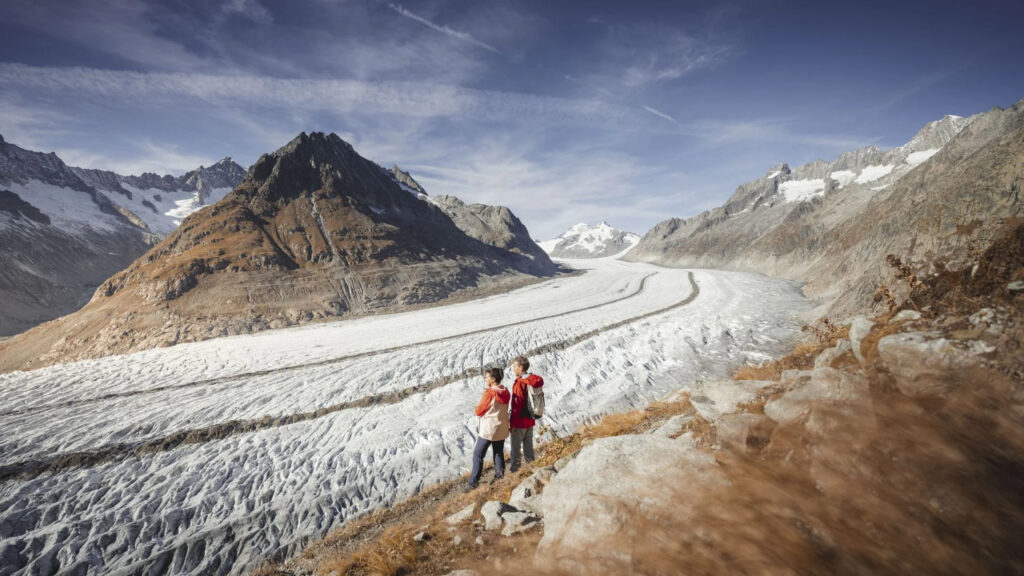
Because Aletsch Glacier is part of a protected World Heritage landscape, responsible tourism is essential.
Mountain environments can be fragile.
Visitors should remain on designated trails, avoid damaging vegetation, carry rubbish away, and respect wildlife.
It is also important to follow local signs and restrictions.
The glacier itself should not be treated like an ordinary hiking trail.
Walking directly across glacial terrain can involve serious hazards such as crevasses, unstable ice, and changing conditions.
Switzerland Tourism states that visitors may hike across the glacier only when accompanied by a guide.
This is an important distinction.
You can safely enjoy many glacier viewpoints and surrounding trails without stepping onto the ice itself.
If you want to experience the glacier directly, use a properly organized guided experience rather than attempting to explore glacial terrain independently.
Take a Guided Glacier Tour
For travelers who want to get closer to the ice, guided glacier experiences can provide a memorable introduction to the glacial environment.
Switzerland Tourism notes that glacier treks and guided glacier hikes are available in the region and specifically states that crossing the glacier should be done with a guide.
A guided experience can also provide educational information.
A knowledgeable mountain guide can explain glacial formations, crevasses, ice movement, surrounding geology, and mountain safety.
The experience is therefore about more than simply walking on ice.
However, glacier conditions can change, and activities may be restricted depending on weather and safety conditions.
Always follow the current advice of qualified local guides and operators.
Best Time to Visit Aletsch Glacier
The best time to visit depends on what you want to do.
Summer is generally the most convenient season for hiking and sightseeing.
Mountain trails are more likely to be accessible, daylight hours are longer, and many mountain transportation services are operating.
Summer also provides the classic combination of green Alpine meadows, rocky peaks, and bright glacier views.
Autumn can offer a quieter experience.
The forests may begin changing color, while cooler temperatures create a different atmosphere across the mountains.
However, visitors should pay closer attention to seasonal transportation schedules and trail conditions.
Winter transforms the region into a snowy mountain destination.
The Aletsch Arena is also a winter sports area, and the surrounding resorts offer opportunities for skiing and other snow activities. Switzerland Tourism notes that the elevated Aletsch Arena has conditions well suited to winter sports.
Spring can be more complicated for hiking because snow can remain at higher elevations while lower areas begin warming.
Rather than choosing a season based only on photographs, consider the activities you want to do and check current conditions before booking.
How to Get to Aletsch Glacier
There is no single road leading directly to the glacier.
Instead, visitors generally access the surrounding viewpoints and mountain villages through public transportation and mountain railways.
The Aletsch Arena can be reached from the Rhône Valley, with mountain transportation connecting the valley to Riederalp, Bettmeralp, and Fiescheralp.
The mountain villages are largely car-free, which contributes to their peaceful atmosphere.
Another important access point is Jungfraujoch on the northern side of the glacier.
Switzerland Tourism identifies both Jungfraujoch and the Aletsch Arena as excellent locations for viewing the glacier.
This gives travelers several options depending on their itinerary.
If you are already exploring the Jungfrau Region, Jungfraujoch can provide an opportunity to see the glacier from another perspective.
If you are traveling through Valais, the Aletsch Arena provides convenient access to major viewpoints.
Visit from Jungfraujoch
Jungfraujoch offers another famous perspective of Aletsch Glacier.
From the high plateau, visitors can look toward the glacier and surrounding high-Alpine peaks.
Switzerland Tourism identifies Jungfraujoch as one of the best places to view the UNESCO World Heritage landscape.
A visit to Jungfraujoch can therefore complement an Aletsch Arena trip.
The perspectives are different.
From the Aletsch Arena, you can see the glacier stretching through the mountains from the Valais side.
From Jungfraujoch, you experience the high-Alpine environment near its northern origins.
If your Switzerland itinerary allows enough time, seeing both sides can provide a much more complete understanding of the landscape.
However, do not try to squeeze both experiences into an unnecessarily rushed day.
Mountain travel is more enjoyable when you allow time for weather changes, transportation schedules, and walking.
Best Hiking Routes Around Aletsch Glacier
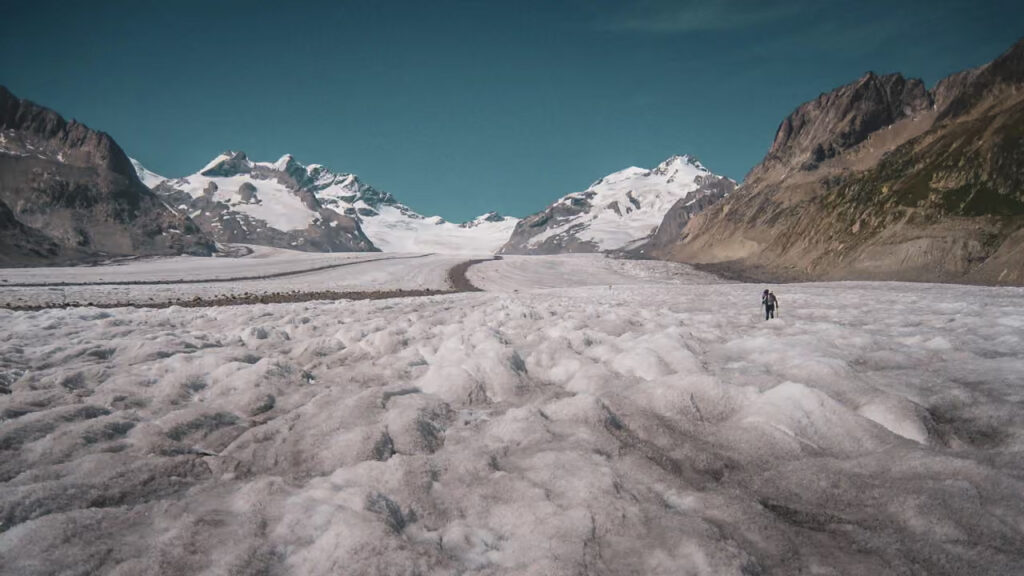
The hiking network around Aletsch Glacier is one of its biggest attractions.
The Aletsch Arena currently advertises approximately 300 kilometers of hiking trails.
This provides enormous flexibility.
Short walks can introduce visitors to the landscape without requiring a full-day commitment.
Longer panoramic hikes can connect several viewpoints.
Forest trails provide a different environment from exposed mountain ridges.
One popular route travels from Bettmerhorn toward Märjelensee and then continues toward Bettmeralp.
Other trails connect the major viewpoints and mountain villages.
The best trail depends on your experience, fitness, available time, and weather.
Do not choose a route simply because a photograph looks spectacular.
Read the official trail information carefully and consider elevation gain, terrain, distance, and current conditions.
A route that looks easy on a map can feel significantly more demanding at high elevation.
Photography at Aletsch Glacier
Aletsch Glacier is a dream destination for landscape photographers.
The enormous variety of viewpoints means that you can create very different images within the same region.
From Eggishorn, you can photograph the sweeping glacier and surrounding peaks.
From Bettmerhorn, you can capture the glacier alongside the Rhône Valley.
From forest trails, trees can frame distant views of the ice.
From higher ridges, the scale of the entire landscape becomes the main subject.
Weather can also improve photographs rather than ruin them.
Clouds around mountain peaks can create depth and atmosphere.
Fresh snow can add contrast.
Low morning light can emphasize ridges and textures.
Even changing weather can create memorable scenes.
If you are photographing the glacier, remember that conditions at high elevation can be colder and more changeable than expected.
Protect your equipment from moisture and keep yourself comfortable enough to spend time outdoors.
What to Pack for Aletsch Glacier
Your packing list should depend on the season and activities.
For a summer day trip, consider bringing:
- Comfortable hiking shoes
- Warm layers
- Waterproof jacket
- Sunglasses
- Sunscreen
- Water
- Snacks
- Small backpack
- Phone or camera
- Basic personal essentials
Higher elevations can feel significantly colder than the valley, even during summer.
For longer hikes, proper hiking footwear becomes particularly important.
If you plan to use mountain transportation and then walk along exposed trails, bring layers that allow you to adjust to changing temperatures.
Winter visitors require appropriate cold-weather clothing and footwear.
Most importantly, check the weather and trail conditions before leaving.
The mountains should be treated as a changing environment rather than a predictable sightseeing attraction.
Where to Stay Near Aletsch Glacier
The Aletsch Arena provides several accommodation options in the mountain villages of Riederalp, Bettmeralp, and Fiescheralp.
Staying in one of these villages can provide a more immersive Alpine experience.
You can wake up close to the mountains and begin your day without first traveling from a distant city.
Bettmeralp can be particularly convenient for travelers interested in glacier viewpoints and mountain trails.
Riederalp provides easy access toward the Aletsch Forest and other nearby attractions.
Fiescheralp is a useful base for exploring the Eggishorn area.
Alternatively, travelers can stay in larger towns in the surrounding Valais region and make day trips toward the mountain destinations.
The best choice depends on your budget, itinerary, preferred atmosphere, and how much time you want to spend in the mountains.
Visit Aletsch Glacier with Family
Aletsch Glacier can be suitable for families because not every experience requires a demanding hike.
Mountain transportation provides access to high viewpoints, while easier walking routes allow families to explore at a comfortable pace.
Children can enjoy cable-car journeys, panoramic viewpoints, forests, mountain villages, and the dramatic sight of the glacier.
The destination can also become an educational experience.
You can explain how glaciers shape valleys, how plants colonize newly exposed land, and why mountain ecosystems are important.
For families, it is especially important to choose trails according to children’s abilities and current conditions.
Do not assume that every scenic trail is suitable for young children simply because it appears short.
Check terrain, exposure, elevation, and weather before setting out.
How Many Days Do You Need?
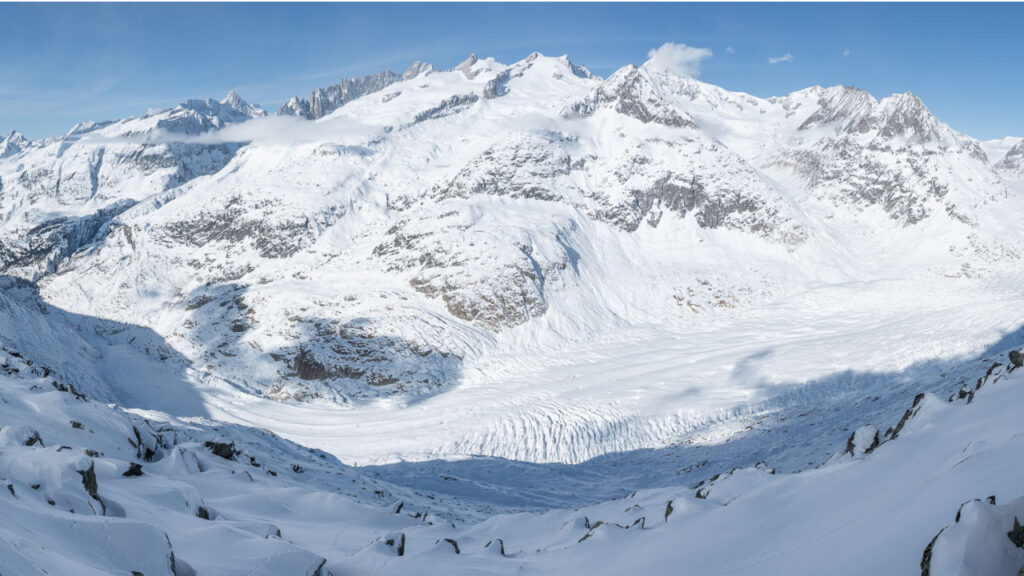
You can see Aletsch Glacier in a single day, but spending more time in the area allows you to experience much more.
A one-day visit could focus on one major viewpoint and a short hike.
A two-day itinerary could include a viewpoint such as Eggishorn or Bettmerhorn on the first day and the Aletsch Forest or another panoramic trail on the second.
Three or more days would allow you to explore several mountain villages, viewpoints, hiking routes, and surrounding attractions.
If you are combining the glacier with Jungfraujoch, additional time can be particularly useful.
The biggest advantage of staying longer is flexibility.
Mountain weather can change.
A cloudy afternoon may hide the glacier, while the following morning could offer crystal-clear views.
Having an extra day gives you a better chance of experiencing the landscape under good conditions.
Aletsch Glacier and Climate Change
Aletsch Glacier is also an important place to understand the effects of climate change.
Glaciers are dynamic environments, and their size and condition can change over time.
UNESCO specifically identifies the retreat of glaciers and the resulting ecological succession as important characteristics of the Swiss Alps Jungfrau-Aletsch World Heritage site.
As glaciers retreat, newly exposed land can gradually become colonized by vegetation.
This creates opportunities to observe ecological change directly within the landscape.
The glacier therefore represents both natural beauty and an important scientific record.
For travelers, seeing the glacier can provide a more tangible understanding of environmental change than reading about it in a textbook.
It is a reminder that mountain landscapes are not frozen in time.
They continue to evolve.
Responsible Travel Around Aletsch Glacier
Responsible travel matters greatly in this region.
The Aletsch landscape contains fragile Alpine ecosystems, protected areas, forests, wildlife habitats, and glacial environments.
Visitors should follow marked trails and local regulations.
Avoid leaving rubbish behind.
Do not disturb animals.
Avoid damaging plants.
Respect other hikers and local communities.
If you are participating in a glacier activity, follow the instructions of your qualified guide.
The UNESCO World Heritage site identifies tourism management and climate change among the key management issues for the region.
This makes responsible tourism more than a general recommendation.
It is part of protecting a landscape recognized internationally for its natural value.
Is Aletsch Glacier Worth Visiting?
Aletsch Glacier is absolutely worth visiting if you want to experience one of Switzerland’s most impressive mountain landscapes.
Its appeal goes beyond the size of the glacier.
The surrounding region combines ice, rock, snow, forests, mountain villages, lakes, hiking trails, and panoramic viewpoints.
It is also accessible in different ways.
You can use mountain transportation to reach major viewpoints, walk through forests, hike along panoramic routes, or join a guided glacier experience.
This variety makes the destination suitable for different travel styles.
You do not have to be an expert hiker to appreciate the landscape.
You simply need enough time to slow down and explore it.
Final Thoughts on Aletsch Glacier
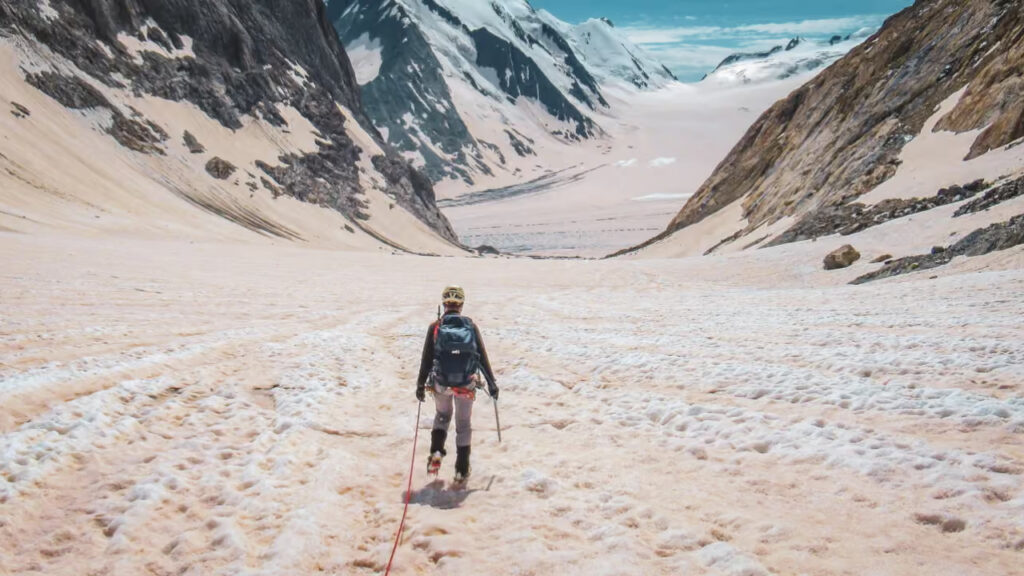
Aletsch Glacier is one of those Swiss destinations that can make photographs feel almost unreal when you finally see the landscape in person.
The enormous river of ice winds through a dramatic Alpine setting surrounded by peaks, rocky ridges, forests, and valleys.
From Eggishorn and Bettmerhorn to Moosfluh and Hohfluh, the region offers countless ways to experience the glacier.
The Aletsch Forest provides a quieter perspective, while the mountain villages of Riederalp, Bettmeralp, and Fiescheralp offer convenient places to stay and explore.
For travelers with more time, hiking routes and guided glacier experiences provide opportunities to go beyond sightseeing.
The destination also offers something more meaningful.
Aletsch Glacier is part of a UNESCO World Heritage landscape that provides evidence of geological processes, ecological change, and the continuing effects of climate change.
Visiting therefore becomes more than simply seeing a beautiful glacier.
It is an opportunity to experience a landscape that has been shaped over immense periods of time and continues to change today.
Plan your visit around the season, check current mountain transportation and trail information, prepare properly for changing Alpine weather, and give yourself enough time to explore.
Whether you visit for one spectacular viewpoint or spend several days hiking through the surrounding mountains, Aletsch Glacier is a destination that can become one of the most memorable experiences of a Switzerland adventure.